
Earthquake Early Warning - Blog
2022-06-20: Equipment for Remote EEW Stations
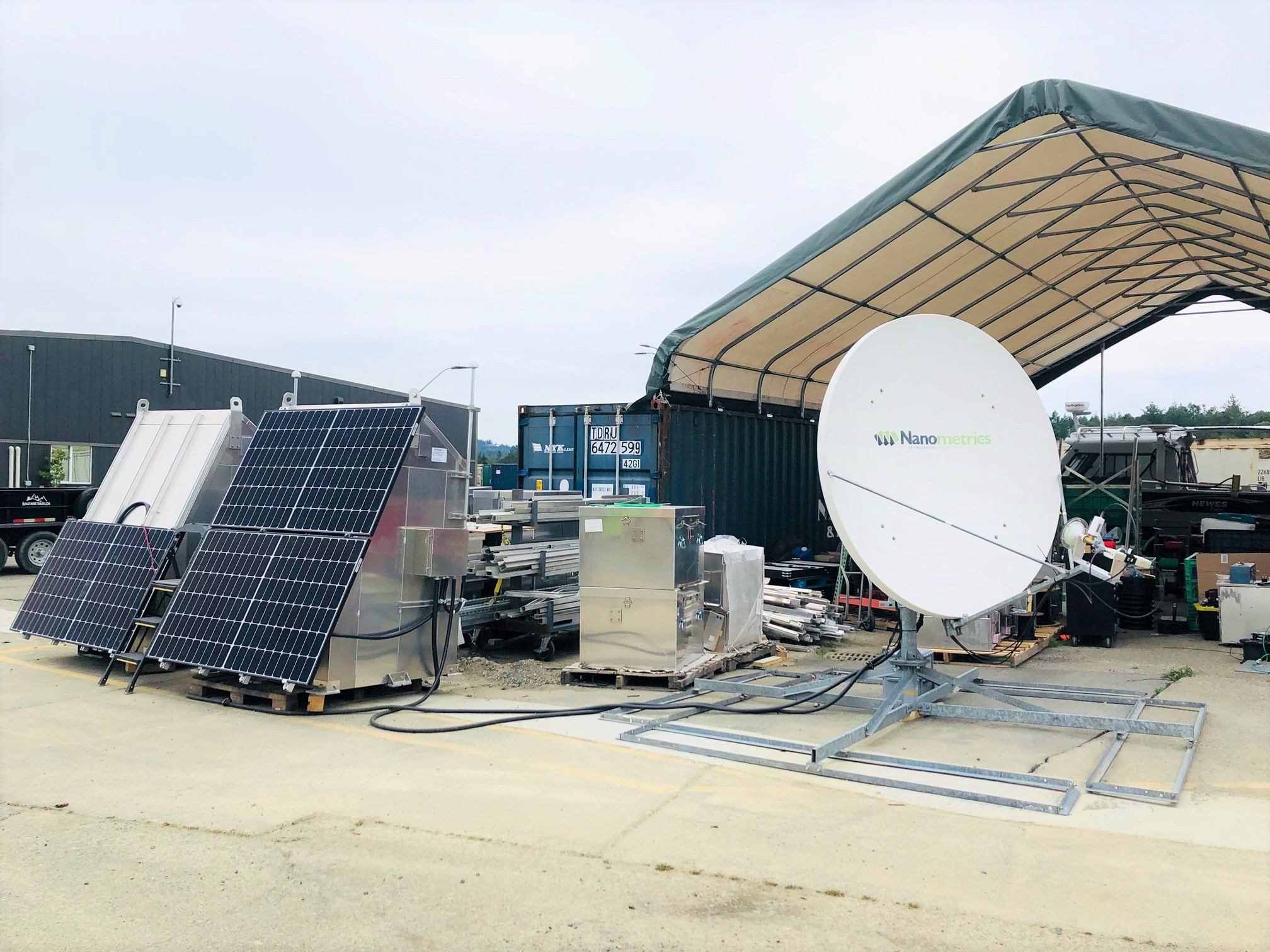
Last week, our field specialists completed testing on equipment that will be installed at remote sites on Haida Gwaii this summer. The huts will help protect the Earthquake Early Warning stations from hurricane-force winds, and are based on a design by colleagues in the United States. Solar panels and batteries will ensure the stations have power, and satellite dishes will send earthquake data to our computer centres. This combination of equipment is ideal for numerous EEW stations which will be installed in remote regions of Canada.
2022-06-08: Student creates "artificial earthquakes" to test the EEW system

As a cooperative student working for the Earthquake Early Warning (EEW) program, Bianca Angheluta helped to develop "artificial earthquakes" in order to test the EEW system. These are computer-generated seismograms to simulate the signals received from natural earthquakes. Large, damaging earthquakes have occurred in Canada in the past, but have been infrequent during recent decades, when modern monitoring equipment was used. The artificial earthquakes are used to supplement the recorded events, to test the EEW system more extensively. This ensures the EEW system will be effective for the various earthquakes that can occur throughout the high-risk areas of Canada - primarily western British Columbia, eastern Ontario, and southern Quebec.
To ensure the method for producing the artificial earthquakes was valid, the same method was used to create seismograms for recorded earthquakes. For example, Bianca generated artificial seismograms for the 2010 magnitude 5.0 Val-des-Bois earthquake, then compared these to the recorded seismograms; the artificial and natural records matched well, meaning this process can be used to test the EEW system.
2022-05-02: Emergency Preparedness Week
Emergency Preparedness (EP) Week is an ideal opportunity to review your emergency plan, ensure your emergency kit is up-to-date, and discuss with your family and co-workers how to respond to various risks. There are numerous ways to prepare for earthquakes, including holding an earthquake drill at home and at work.
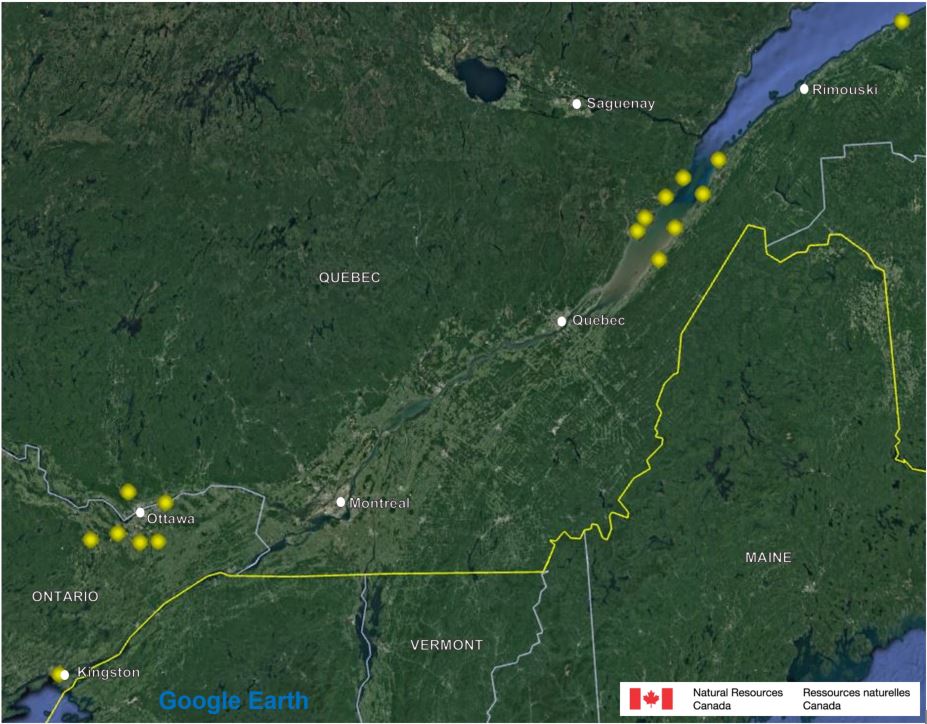
This EP Week, we are proud to mark the installation of the first few Earthquake Early Warning stations in Ontario and Quebec. These will be part of a network which, once established, will have over 400 stations in areas of earthquake risk in Canada. The national EEW system will give seconds to tens-of-seconds of warning before the arrival of strong shaking, allowing people to protect themselves, via Drop, Cover and Hold on.
2022-04-26: Richter Scale Day

Today, seismologists around the world celebrate the birth of Charles Richter, on this day in 1900. Professor Richter was a scientist who is most famous for developing the Richter Scale, the first magnitude scale for describing the size of an earthquake. The scale, denoted by ML, is logarithmic, meaning an ML 6 earthquake is ten times the strength of a ML 5 and 100 times that of an ML 4.
Magnitude is an indication of the size of the earthquake. Intensity describes the strength of shaking and other effects, such as levels of damage. An earthquake has one magnitude, but can have many different intensities. Intensities are usually high close to the earthquake, where the shaking is strong, and become smaller further from the earthquake, where the shaking is weak.
NRCan's Earthquake Early Warning system will alert regions where intensities will be relatively high, indicating earthquake shaking strong enough to cause damage or injury.
2022-03-28: First installation of a national EEW station at BC Ferries' terminal
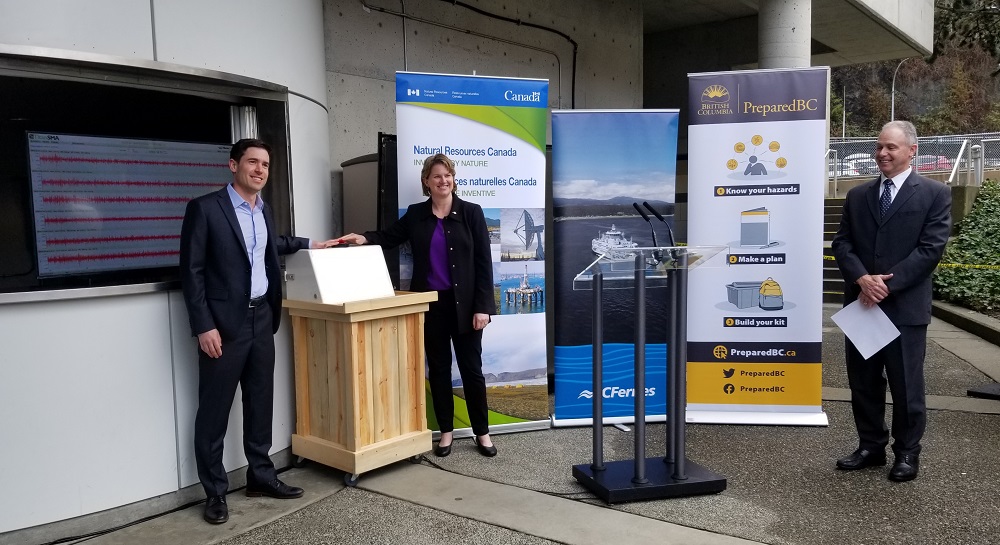
Today, we celebrated the installation of the first Earthquake Early Warning (EEW) station at BC Ferries' Horseshoe Bay terminal. This station and several others at BC Ferries' terminals are ideally located to contribute to the extensive network being established for the national EEW system. The launch of this station was marked by a welcome from BC Ferries' CEO Mark Collins, remarks on earthquake preparedness by BC Provincial Parliamentary Secretary Jennifer Rice, and an introduction to the EEW system by MP Patrick Weiler. The event's finale was the pressing of a red button to turn on the EEW equipment and begin transmission of seismic data. As more of the network stations are installed, we will be testing the EEW system by sending EEW alerts to critical infrastructure (CI) operators, such as BC Ferries. Once the EEW system is fully operational, in 2024, CI operators will receive EEW alerts specific to their needs. The public will automatically receive alerts through the NPAS system.
2022-03-24: Japanese EEW system halts train in Tohoku earthquake
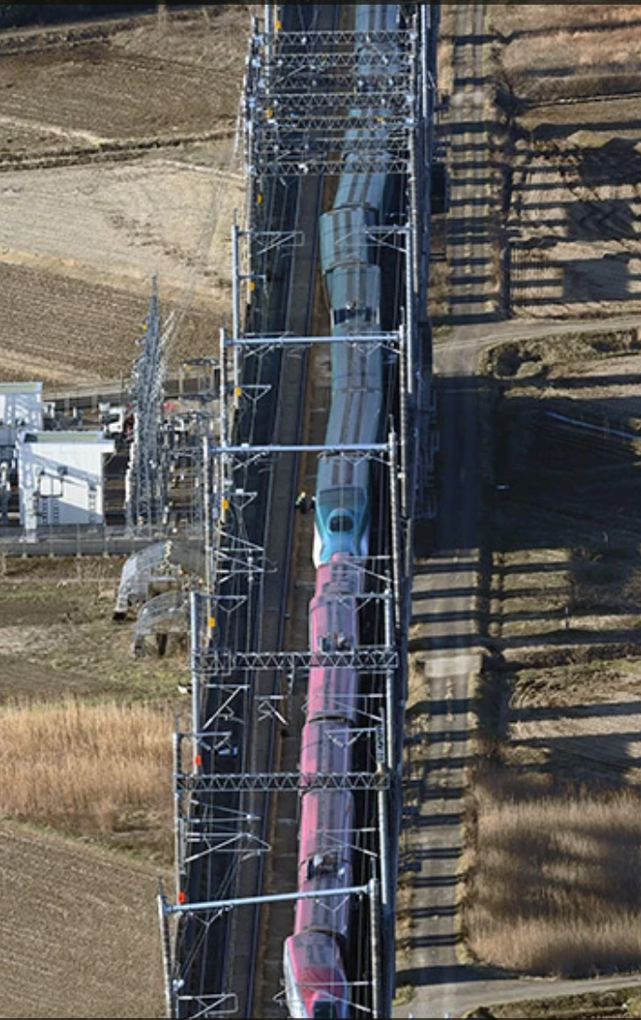
Last week, while riding the Tohoku Shinkansen through Shiroishi, Japan, Yohei Nakagawa and other passengers received an earthquake alert on their smartphones. The train had also received an EEW alert and automatically made an emergency stop. Five seconds later, strong shaking from the earthquake arrived, swaying the train violently. Only a minor derailment occurred, however, and no crew or passengers were injured. It could have been far worse, had the train not stopped. The EEW alert and the protective actions taken likely saved lives, and prevented serious injuries and damage. [image and story courtesy of The Asahi Shimbun]
Once Canada's national EEW system is launched in 2024, we look forward to ways in which EEW alerts might be used to reduce damage, impacts to operations, and injuries, through triggering of automated response technologies. To begin this process, earlier this month NRCan met with representatives from the Transportation and Health sectors in British Columbia, to introduce them to the EEW programme and discuss ways in which EEW alerts could be used to make their operations safer. These sessions will also inform future workshops with the various critical infrastructure sectors in Canada.
2021-11-25: Saguenay earthquake
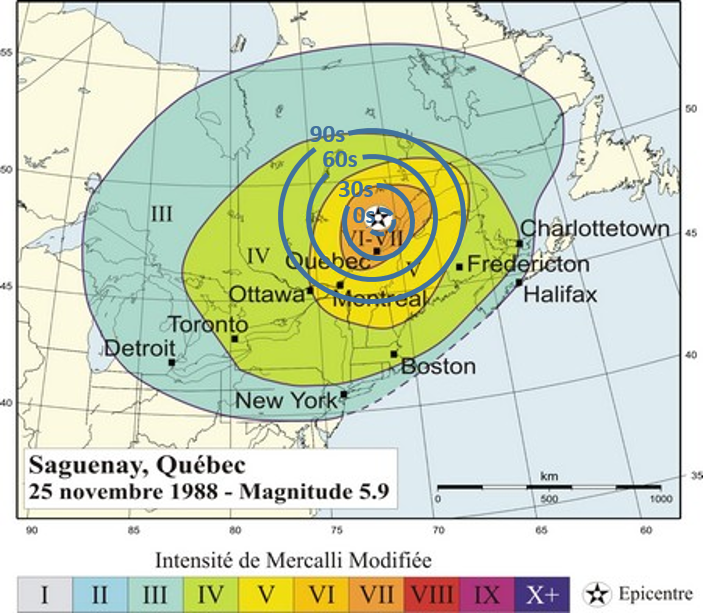
On this day in 1988, a magnitude 5.9 earthquake struck the Saguenay region in Quebec, north of Quebec City. Strong shaking was reported in Quebec City and moderate shaking in Montreal. The earthquake was felt as far away as Halifax, Charlottetown, New York and Detroit. Thankfully, the earthquake caused no structural damage and no lives were lost, but there were numerous reports of falling debris (such as bricks and building contents) that can easily cause injury. Additionally, the shaking caused slumping and landslides in the region, impacting rail lines.
Once the EEW system is operational, a repeat of the Saguenay earthquake would generate alerts of 29 seconds for Quebec City and 84 for Montreal.
2021-10-21: Pre-ShakeOut 3 - ShakeOut earthquake drill
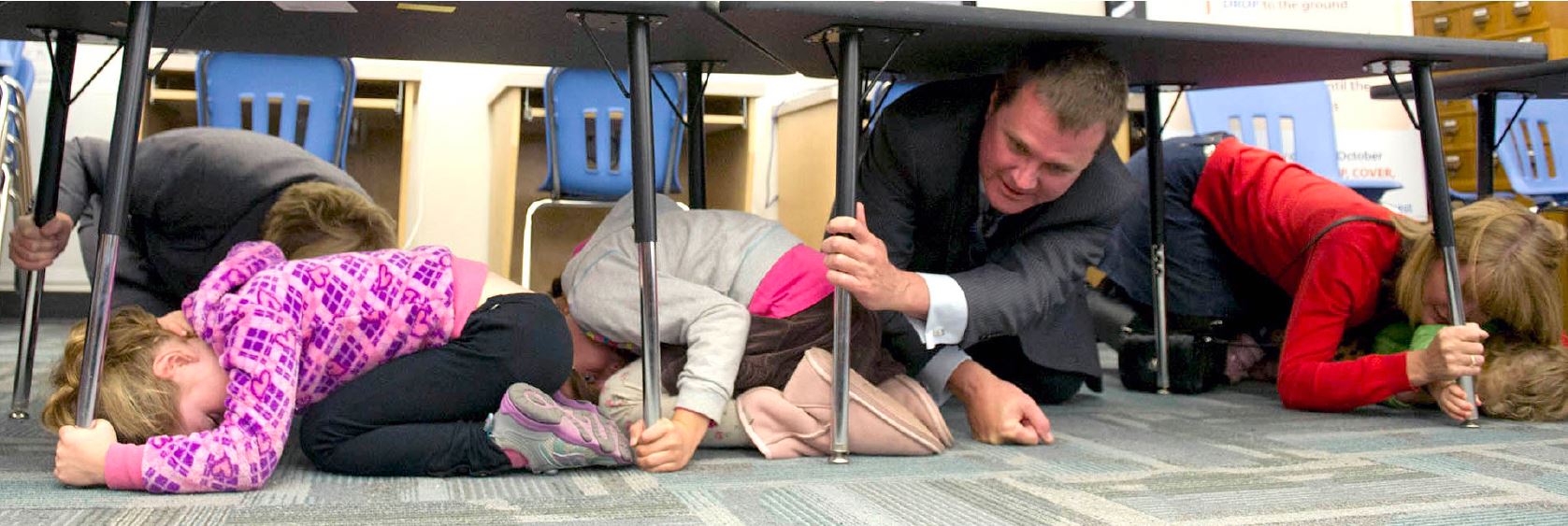
Today Canada joins millions of people around the world in the annual ShakeOut earthquake drill. By practicing the safest response to earthquake shaking or the receipt of an Earthquake Early Warning alert, you will create muscle memory that should take you to a safe space during an earthquake. If you don’t manage to do practice Drop, Cover, and Hold on today, you can do it any time – at work and at home.
2021-10-18: Pre-ShakeOut 2 - How to respond if you are outside during an earthquake
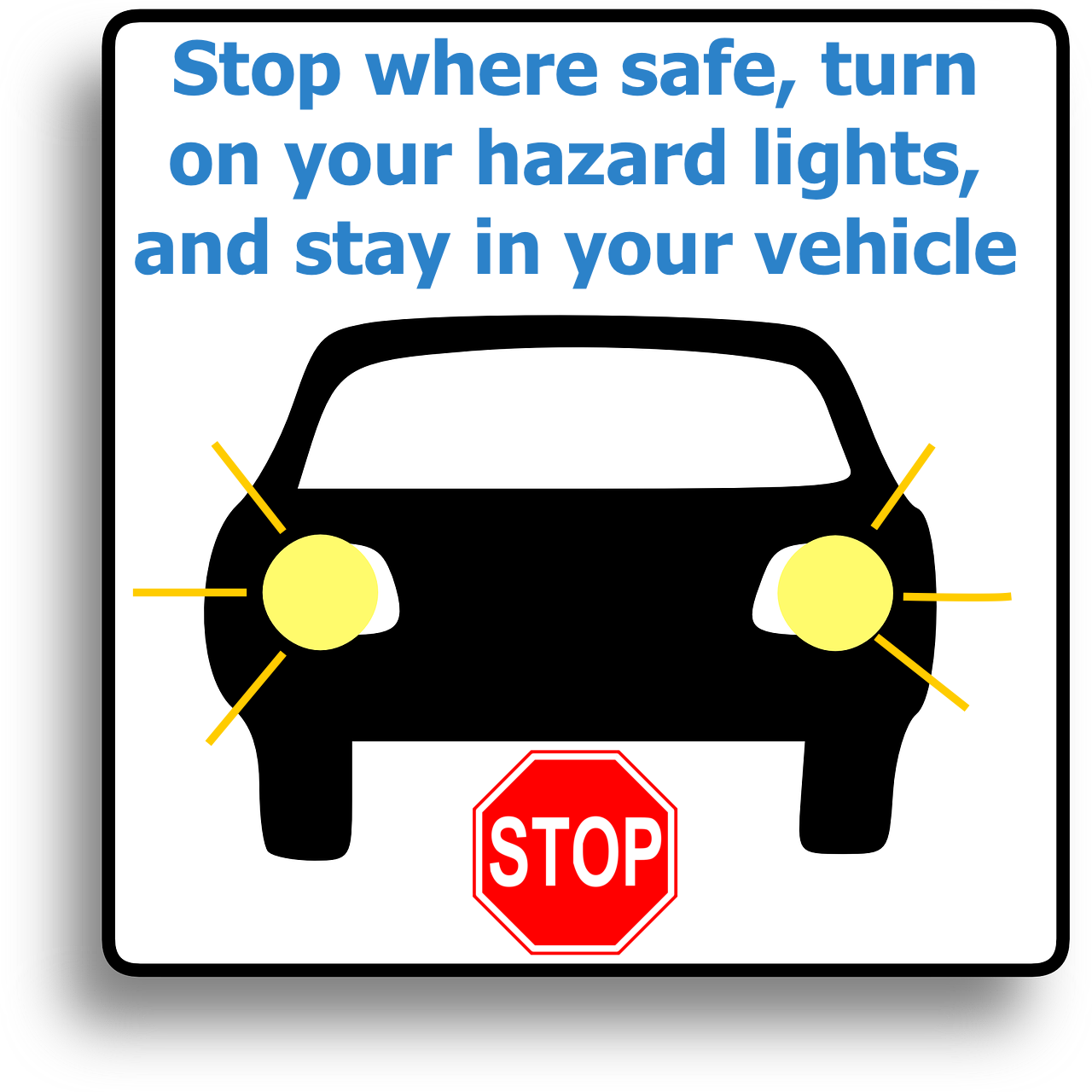
If you are outside during an earthquake or when you receive an Earthquake Early Warning alert, move to a safe space, away from old, masonry buildings or those with a lot of glass, then Drop to the ground and Cover your head and neck with your arms. If you are driving, Slow down, Pull over somewhere safe (away from older buildings and overpasses), turn on your hazard lights, and Stay inside your vehicle until the shaking has stopped. In both situations, watch for hazards, such as downed electrical lines and building components which look damaged or otherwise unsafe.
See other ShakeOut Fact Sheets
for how to respond in a variety of situations.